


Maine’s Clean Energy Economy is the Fastest Growing in New England
Join us on April 16 at noon for E2Tech’s Growing Maine’s Clean Energy Economy webinar, featuring the Maine Department of Energy Resources, Evergreen Home Performance, ReVision Energy, and other clean sector leaders.
More than 16,000 clean energy workers in Maine contributed $3 billion to the state’s economy in 2024 - Maine has the fastest growing clean energy economy in New England!
“Maine’s success comes from public and private investments made over decades in the education of Maine’s workforce and energy consumers through our schools and the Efficiency Maine Trust as well as support of innovators and entrepreneurs by organizations like the Maine Technology Institute,” said Orion Breen, E2Tech’s executive director, on the new Maine Clean Energy Industry Report released by the Maine Department of Energy Resources (DOER).
“Since the 1990s, environmental and energy professionals have been meeting informally discussing how to grow the green economy,” said Thomas Eschner of TRC/WSP and chair of E2Tech’s Board. “These informal meetings eventually became the Environmental & Energy Technology Council of Maine (E2Tech) to ‘draw on more resources and forge more partnerships that will ultimately mean more jobs and opportunities for Maine’ according to the 2003 press release announcing our new name. It is truly gratifying to see the fruition of this idea and its dedicated and passionate community.”
“NEEP is looking forward to continuing its partnership with Maine DOER as well as The JPI Group and E2Tech, building on the success of the past three years and advancing clean energy jobs in Maine,” said Chase Macpherson, Manager of Community Solutions at Northeast Energy Efficiency Partnerships (NEEP). DOER is launching the Maine Clean Energy Internship Program this spring with NEEP (and assistance from E2Tech). This new program provides opportunities for paid work experience in the clean energy and energy efficiency industries, building on a successful pilot, which placed 60 interns in diverse roles at solar, heat pump, and weatherization contractors, nonprofits, engineering and consulting firms, and more.
“Investments in energy efficiency and clean energy make Maine more energy secure by reducing our exposure to volatile global energy markets while creating good-paying jobs and career opportunities for Maine people,” said Dan Burgess, Acting Commissioner of DOER, in a press release about the new Maine Clean Energy Industry Report. DOER will host a public webinar on April 9 to review the results of the Report with its authors, BW Research.
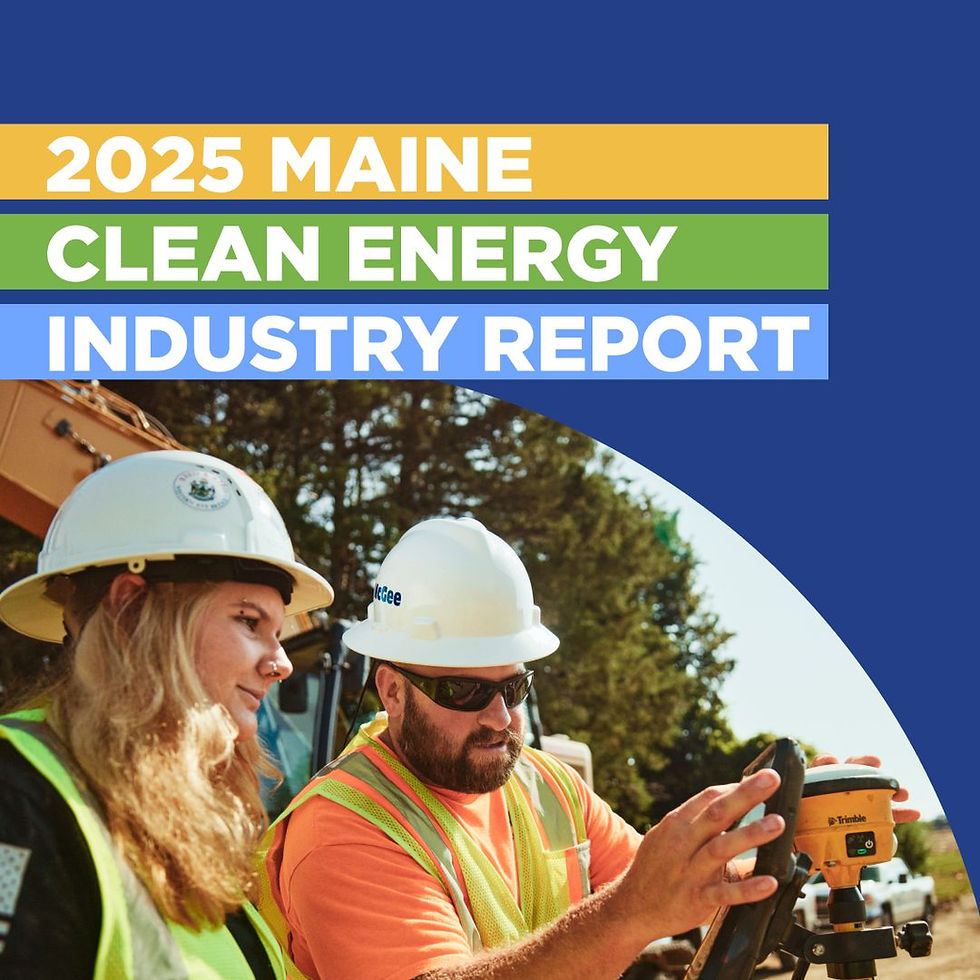
The new Maine Clean Energy Industry Report paints a picture of a sector that is not niche or aspirational. It is here, it is growing, and it is reshaping Maine’s economy in ways that are both measurable and meaningful. In a moment when much of the national conversation about energy is defined by conflict and constraint, Maine offers something different: a story of steady progress, broad-based growth, and emerging opportunity.
At the center of that story is jobs. Maine now supports more than 16,000 clean energy workers—a figure that has been climbing three times faster than Maine’s overall workforce. This is not a speculative industry built on distant promises. These are technicians and electricians installing heat pumps, construction crews building solar arrays, technicians modernizing the grid. The work is tangible, local, and downright essential.

Clean and Traditional Energy Employment in Maine by Technology Sector, 2024

Clean Energy Establishments in Maine by Value Chain Segment, 2024
In a state that has faced economic and demographic headwinds (see E2Tech’s Climate Migration event), this kind of growth signals something important: clean energy is becoming a pillar of long-term economic development. And it is not confined to one corner of the state.
Clean energy jobs are taking root in communities where economic opportunity has often been scarce. Rural counties—places that have historically struggled to attract new industries—are seeing some of the fastest gains. Waldo County had the greatest concentration of clean energy workers in 2024 with 4.7 percent of its overall workforce employed in clean energy, and Lincoln County had the highest concentration of energy efficiency workers with 3.7 percent of its overall workforce. While clean energy employment increased across all counties from 2020 to 2024, Piscataquis County has had the highest relative growth rate in clean energy jobs in Maine (51 percent).
This growth is being shared, and its geographic spread matters. It means the clean energy transition is not just an environmental strategy; it is an economic one that reaches beyond urban centers and into the fabric of the state.
The industry itself is diverse. Energy efficiency remains the largest segment, reflecting the practical reality that the cheapest energy is the energy not used. But renewable generation—solar, wind, and hydro—is expanding. So too are investments in grid infrastructure, battery storage, and clean transportation. Together, these sectors can form a connected ecosystem, each reinforcing the others.
Behind this growth is a powerful alignment of policy, economics, and innovation. State-level goals and strategies around climate, energy, education, and workforce have helped unlock investment and accelerate deployment. Technologies that once seemed expensive or experimental are becoming mainstream, driving demand across residential, commercial, and industrial markets. Fulfilling “the goal of advancing job growth, R&D and new product commercialization” expressed in E2Tech’s 2003 press release.
Of course, we still have very far to go. Maine will need more workers, more training programs, and continued investment in infrastructure to sustain this momentum and achieve its goals. What emerges most clearly from the report is a sense of direction. Maine is not simply reacting to energy challenges; it is helping to shape the clean energy transition. The state is building an economy that aligns environmental responsibility with economic opportunity, proving that the two can move forward together just as we’ve done through innovation in our heritage industries.
In the end, the significance of this moment is about the people behind the numbers. Clean energy in Maine, and “climate dominance” as expressed at the recent ClimateWork Maine Summit, is not just a dream. It is a present reality—powering homes, supporting families, and laying the groundwork for a more resilient and prosperous state.
(E2Tech programs are supported by our members and sustaining partners like the Maine Technology Institute which offers grants, loans, equity investments, and services to foster Maine’s innovation economy.)
Comments