


What Does Maine's Energy Future Look Like? Reflections from E2Tech's Legislative Breakfast Energy Panel
Please like, review and share this E2Tech podcast episode available on YouTube, Spotify and Apple Podcasts!
Reflections from E2Tech's Spring Semester intern, Japhet Els:
As a new intern at E2Tech, I was curious to hear what the annual Legislative Breakfast might look like. Walking into a room filled with legislators, utility leaders, regulators, and clean energy advocates was intriguing for this moment: energy prices are sky-high, especially in New England. If anyone had their finger on the pulse of affordability, surely this roomful of individuals did. (See my top takeaways at the bottom of this article as well as a link to an article by The Maine Monitor about the event. E2Tech’s Legislative Breakfast is a great start to the conversation continued in E2Tech's Legislative Wrap Up podcast as well as E2Tech's GRIDsilience series. The Legislative Breakfast also featured a great environmental panel focused on waste management which was expanded upon in E2Tech's Extended Producer Responsibility (EPR) webinar on 2/26.)
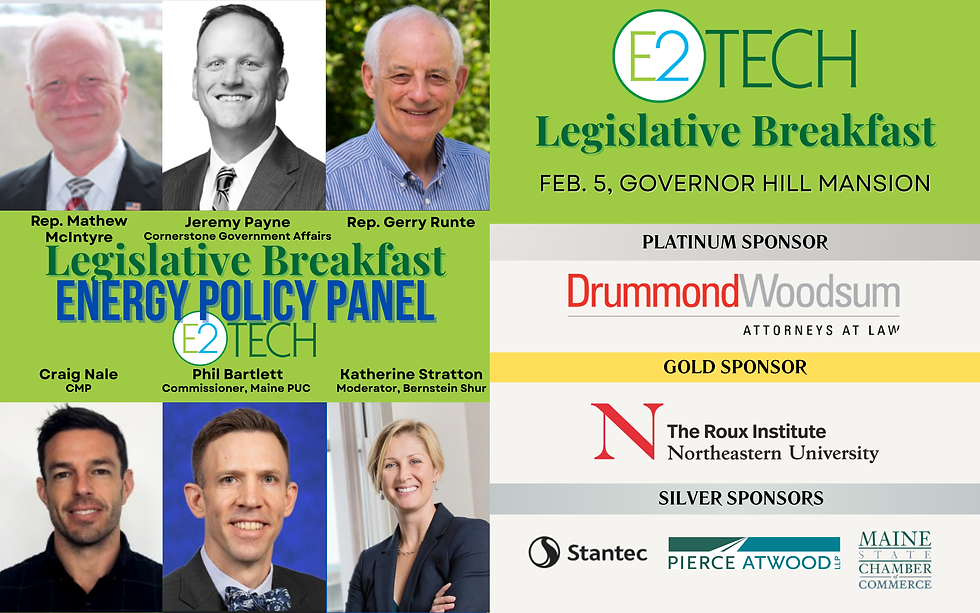
The energy panel, moderated by Bernstein Shur’s Kat Stratton, brought together PUC Chair Phil Bartlett, Representatives Matthew McIntyre and Gerry Runte, Craig Nale from Central Maine Power, and Jeremy Payne from Cornerstone Government Affairs (and former executive director of the Maine Renewable Energy Association. Their discussion centered on two critical questions: What does Maine's energy future look like? and How are energy leaders addressing affordability?
What struck me most wasn't just the complexity of these challenges, but clear agreement among all panelists about what's holding Maine back—and what we need to do about it.
Maine's Energy Future: Beyond Ideology
Representative McIntyre, a first-term legislator and former Navy nuclear propulsion machinist, opened the discussion by identifying what he sees as Maine's biggest obstacle to achieving our energy goals: political partisanship…
"One of the biggest things right now I see as the obstacle is ideology, political partisanship... electrons may have a charge of negative one, but they're supposed to be politically neutral."
This theme echoed throughout the discussion. Representative Runte, who brings deep energy industry experience to his legislative work (as reflected in his Energy Mosaics blog), noted that policy is often "driven by narratives rather than grounded in solid analysis," and that better cost-benefit analysis is essential. The panelists agreed that Maine's energy future requires moving beyond ideological positioning toward a "properly diversified energy portfolio that's based upon science, and not about passions," according to Rep. McIntyre.
Blaming politics and ideology isn’t new to any policy conversation these days. Partisanship can complicate already complicated issues. And yet, the panel’s back and forth highlighted many areas of alignment among diverse parties.
Affordability: It's Everything, All at Once
If there was one theme that dominated the conversation, it was affordability. PUC Chair Phil Bartlett didn't mince words:
"To me, the biggest challenge we're facing right now is affordability. We're seeing upward pressure on every component of the bill."
Bartlett broke down where these cost pressures are coming from, and it was eye-opening to see how interconnected everything is:
Electric supply costs: Maine's electricity prices are closely tied to natural gas, which spikes dramatically during cold weather. During January 2025's cold snap, wholesale prices hit over $441/MWh—far above typical prices around $135/MWh.
Transmission infrastructure: Assets installed 50-70 years ago are reaching end-of-life. Replacing them is expensive, and ratepayers might not see visible benefits—just continued service.
Distribution modernization: The grid needs upgrades to handle EVs, heat pumps, and distributed solar—all part of Maine's clean energy future.
Public policy costs: Representative McIntyre noted that an increasing percentage of his Versant bill consists of public policy charges—charges that fund energy efficiency programs, low-income assistance, renewable energy incentives, and other state priorities.
What’s more, these cost pressures compound each other. When every component of the bill is increasing, it becomes difficult to make any new investments—even investments that could ultimately save money or improve reliability—because people are running out of bandwidth to pay.
But, how do we pay for it?
One of the topics centered on a recent legislative development: LD 839, which created an account to accept general fund appropriations for Efficiency Maine programs. Craig Nale from CMP highlighted how this represents a fundamental shift in thinking about "the costs of achieving the goals that we have and the ways that we're choosing to pay to achieve those goals."
The logic is compelling: by funding some energy programs through general taxation rather than ratepayer charges, costs can be allocated more equitably based on ability to pay. A progressive tax system takes income and overall wealth into account; uniform ratepayer charges don't.
Jeremy Payne emphasized that solving affordability requires first agreeing on what "affordability" actually means. Just as "energy independence" meant different things to different people 20 years ago, we need a shared understanding of affordability before we can design effective policies to achieve it. Today, when it seems that many parts of life are unaffordable, agreeing on what’s affordable when it comes to energy costs is that much more challenging.
Planning amidst chaotic, accelerated change
Sometimes it feels like the old systems just can’t keep up. The tension that exists between the pace of comprehensive planning and the reality of rapid societal change presents another hurdle. Maine's integrated grid planning process brings together nearly 100 stakeholders to develop 10-year plans for grid investments. Commissioner Bartlett praised this for establishing "a shared vocabulary" about system needs and noted the need for more opportunities for stakeholders to come together and come closer to consensus.
Craig Nale identified a fundamental challenge: "There's some clear tension relying on a 10-year grid plan that was developed using a specific forecast at a specific point in time when so much is changing around us all the time." He cited EV incentives being enacted and then repealed within three years as an example of how quickly the policy and planning landscape can shift.
Representative Runte highlighted another planning challenge: fragmentation. He noted that while individual initiatives seem interesting, they often have ramifications that aren't considered comprehensively. Commissioner Bartlett illustrated this by listing concurrent but separate PUC proceedings on integrated distribution planning, flexible interconnects, non-wires alternatives, time-of-use rates, and multi-year rate cases—each with direct impacts on Maine's energy future, yet operating somewhat independently.
Representative McIntyre said more attention should be put on energy issues but put it bluntly: "We're not clear-eyed because we're so diluted with over 2,000 transactions of legislative business... The sequencing of our decisions is being nullified by distractions of other things." That may be how every issue advocate feels these days, no matter what your priorities may be - energy, environment, or otherwise. It can feel like there’s too much to get done, not enough agreement across the board, and many are often busy pushing their own agenda instead of looking for alignment to take a collective step forward.
Reputation Management for Maine?
Perhaps the most pointed part of the discussion came from Jeremy Payne, who has worked in Maine energy policy for nearly two decades. He emphasized that Maine is competing nationally for energy infrastructure investment:
"There are 49 other states competing for this investment capital. If we make it too hard, they're just not going to look here anymore... if you cannot get a project across the finish line, whether it's the transmission line or distribution line, energy storage project, small modular nuclear reactor, wind project, solar farm, whatever it is, if you can't get to yes, we're not going to be able to do any of these things that we're talking about."
Bernstein Shur’s Katherine Stratton added an important insight: "Developers crave stability more than they crave great things." Understanding the environment they are working in and what it takes to get a timely answer matters more than any single incentive.
Rep. McIntyre expressed related concern about "overregulation" driven by fear of the unknown. He was particularly enthusiastic about advanced geothermal opportunities in Maine but worried that lack of understanding could lead to hasty regulatory barriers: "if they don't understand something, what do they do? They quickly throw up a barrier."
As someone learning about Maine's clean energy economy through the E2Tech lens, I'm seeing firsthand how many innovative companies and technologies are emerging. But innovation doesn’t mean much if projects can't actually get built. (Check out E2Tech’s Energy Permitting podcast.)
Correcting Maine's Natural Gas Overdependence
Commissioner Bartlett explained that Maine's electricity pricing challenge fundamentally stems from natural gas dependency. Natural gas accounted for 55% of New England's electricity generation in 2025. During cold snaps, when gas is also needed for heating, pipeline constraints cause prices to spike dramatically.
The solution, he emphasized, is diversification. The NECEC transmission line, which came online in late 2024, is already delivering "huge price dips and a real price differential for Maine versus the rest of New England." Northern Maine wind procurement and potential contracts for nuclear or other zero-emitting resources with Connecticut represent additional strategies.
Jeremy Payne noted that regional cooperation is finally gaining traction. After years of ineffective collaboration, "governors and regulators across the region [are] saying we don't have a choice but to work together." Indeed, a few successes on some early projects could build the momentum needed for additional regional initiatives that serve as a collective response to a regional energy challenge.
The Infrastructure Crisis We Can't Ignore
Representative McIntyre delivered his own urgent warning:"You mentioned the aging infrastructure. This, folks, this is immediate. We need to get on this and start setting aside some of our competing interests and focus on a long-term solution."
This creates a difficult political reality: spending more money on infrastructure replacement that doesn't deliver visible improvements makes it harder to build support for necessary investments. But the alternative—infrastructure failure—would be far worse.
The Take Home Message and Some Hope
Here’s a TLDR on what I heard at the E2Tech Legislative Breakfast:
Our energy problems are interconnected. It’s hard to solve affordability without addressing natural gas dependency. It’s hard to modernize the grid without permitting reform. It’s hard to achieve climate goals without figuring out how to pay for the transition equitably.
Maine's energy leaders appear to be aligned on the challenges. Across partisan and sectoral divides, there's broad agreement on what's holding Maine back: ideology over evidence, fragmented decision-making, affordability pressures, permitting obstacles, and infrastructure urgency.
Perhaps less so on the emerging solutions. From new funding mechanisms like LD 839 to transmission projects like NECEC to renewed regional cooperation, Maine is making progress, yet perhaps not at the pace everyone would like to see. The question is whether we can scale and accelerate these solutions while avoiding traps that would distract us.
Stability, please. This was a good reminder amidst the technical conversation. Maine doesn't necessarily need to offer the best incentives—we need to offer a predictable, communicative and engaged environment where developers and investors can understand the rules of the game.
Speed matters. Representative McIntyre's urgency about aging infrastructure wasn't political posturing—it was a warning. Some of these challenges require immediate action, not always another stalling study or planning process.
Leaving the Governor Hill Mansion that morning, I was struck by the quality of the conversation even if the solutions weren’t crystal clear or even fully agreed on. These weren't talking points—they were honest assessments of where Maine stands and what we need to do.
Maine's energy future will be shaped not just by the goals we set, but by our ability to create conditions where those goals can actually be achieved.
I'm grateful to E2Tech for creating spaces like the Legislative Breakfast where these conversations can happen. Because Maine's clean energy future isn't just about technology or policy—it's about bringing people together to have hard conversations and generate solutions to solve immediate problems.
And based on what I saw that morning, Maine's energy leaders are ready to do exactly that.
About the Author:
Japhet Els is a new intern with E2Tech, learning about Maine's environmental and energy technology sectors. The Legislative Breakfast was his first major E2Tech event, and he's excited to continue exploring how Maine can build an affordable, resilient, and sustainable energy future.
Thanks to Legislative Breakfast platinum sponsor Drummond Woodsum, our gold sponsor The Roux Institute at Northeastern University, and our silver sponsors Stantec, Pierce Atwood and the Maine State Chamber of Commerce!
(E2Tech programs are supported by our members and sustaining partners like the Maine Technology Institute which offers grants, loans, equity investments, and services to foster Maine’s innovation economy.)

Comments